Find Ethernet Cable Break Distance To Fault Uk
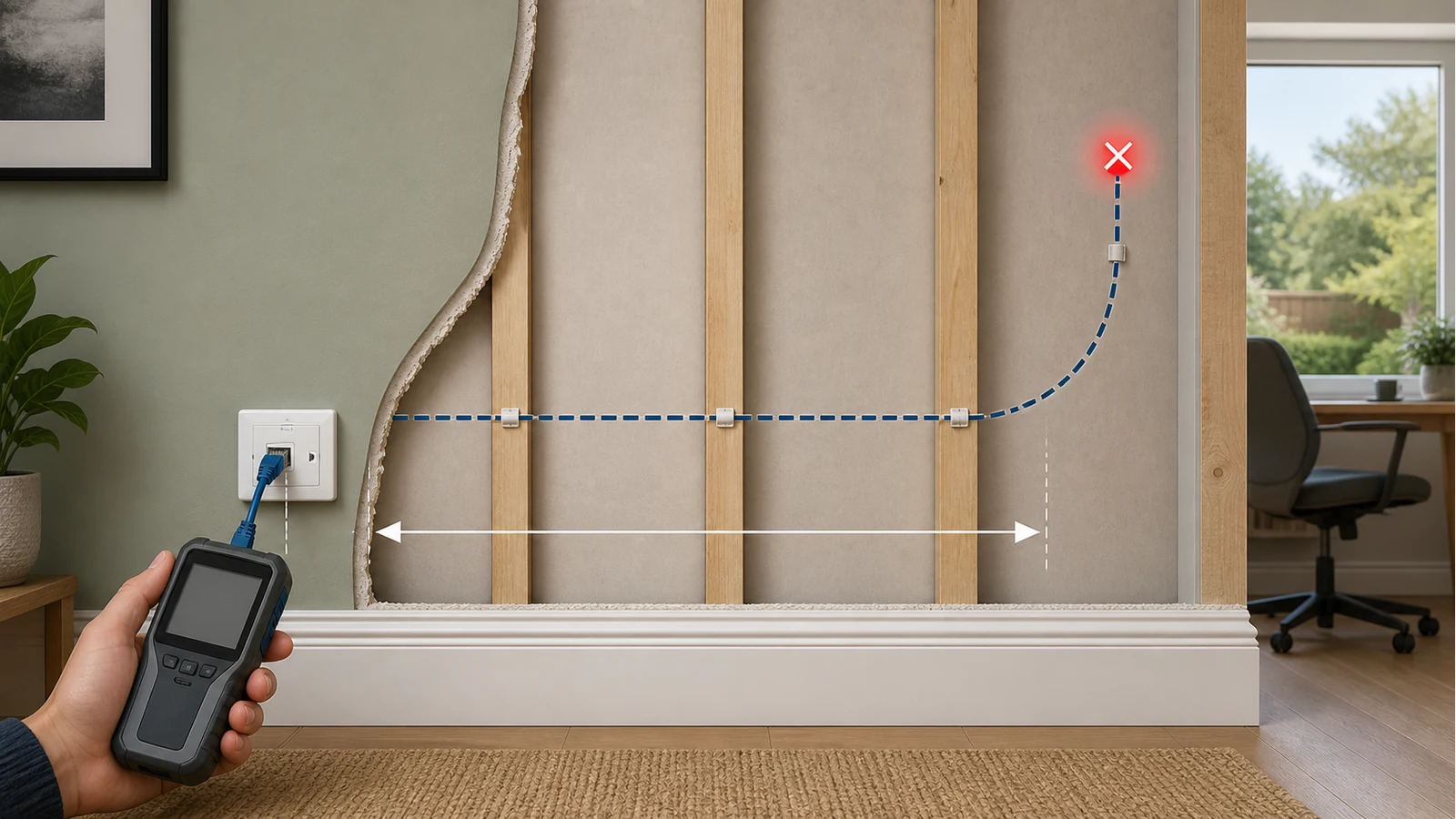
To find an Ethernet cable break distance to fault, first prove the link really has an open or short with a wiremap test, then use a length or TDR-capable tester to estimate how far the fault is from the end you are testing. Treat the distance as a guide to the nearest accessible joint, faceplate, loft run or garden-office entry point, not as surveyor-grade proof.
Why distance-to-fault matters in UK homes and offices
In a plastered wall, loft route or buried garden-office cable, blindly opening the whole run is expensive. Public UK-facing tool pages such as Fluke LinkIQ and Klein Tools VDV Commander describe length and distance-to-fault features for finding opens or shorts. That class of test helps you decide where to inspect first.
Diagnostic ladder
- Disconnect active network equipment at both ends before testing unless your kit explicitly supports the live condition.
- Run a wiremap test. If the wiremap passes, the problem may be a patch lead, switch port, device setting or intermittent fault rather than a hard break.
- If the wiremap shows an open or short, run length or fault-distance mode from the known end.
- Measure along the likely cable route, allowing for vertical drops, cabinet loops and slack.
- Open the nearest accessible point first: faceplate, patch panel, loft junction, external box or conduit entry.
- Repair or re-terminate, then test again from end to end.
Which tester class helps?
| Tool | Useful for this job | Limit |
|---|---|---|
| LED continuity tester | Shows some opens or shorts | Usually no distance estimate |
| Length-capable verifier | Gives an approximate distance to open or short | Accuracy depends on cable type and settings |
| Certifier | Can support formal post-repair handover where required | Overkill for many one-off domestic checks |
Distance readings are not magic
Length calculations depend on the cable construction and velocity setting. The Klein Scout Pro Max UK listing is an example of how length and fault-finding features are described for troubleshooting, but any reading should be checked against the real cable route. A “12 m” fault may mean 8 m across a ceiling and 4 m down a wall, not 12 m in a straight line.
When to escalate
Escalate if the cable is part of a paid structured-cabling handover that requires certification after repair, if the cable may be carrying power that your tester is not rated for, or if the route involves hidden services you cannot safely expose.