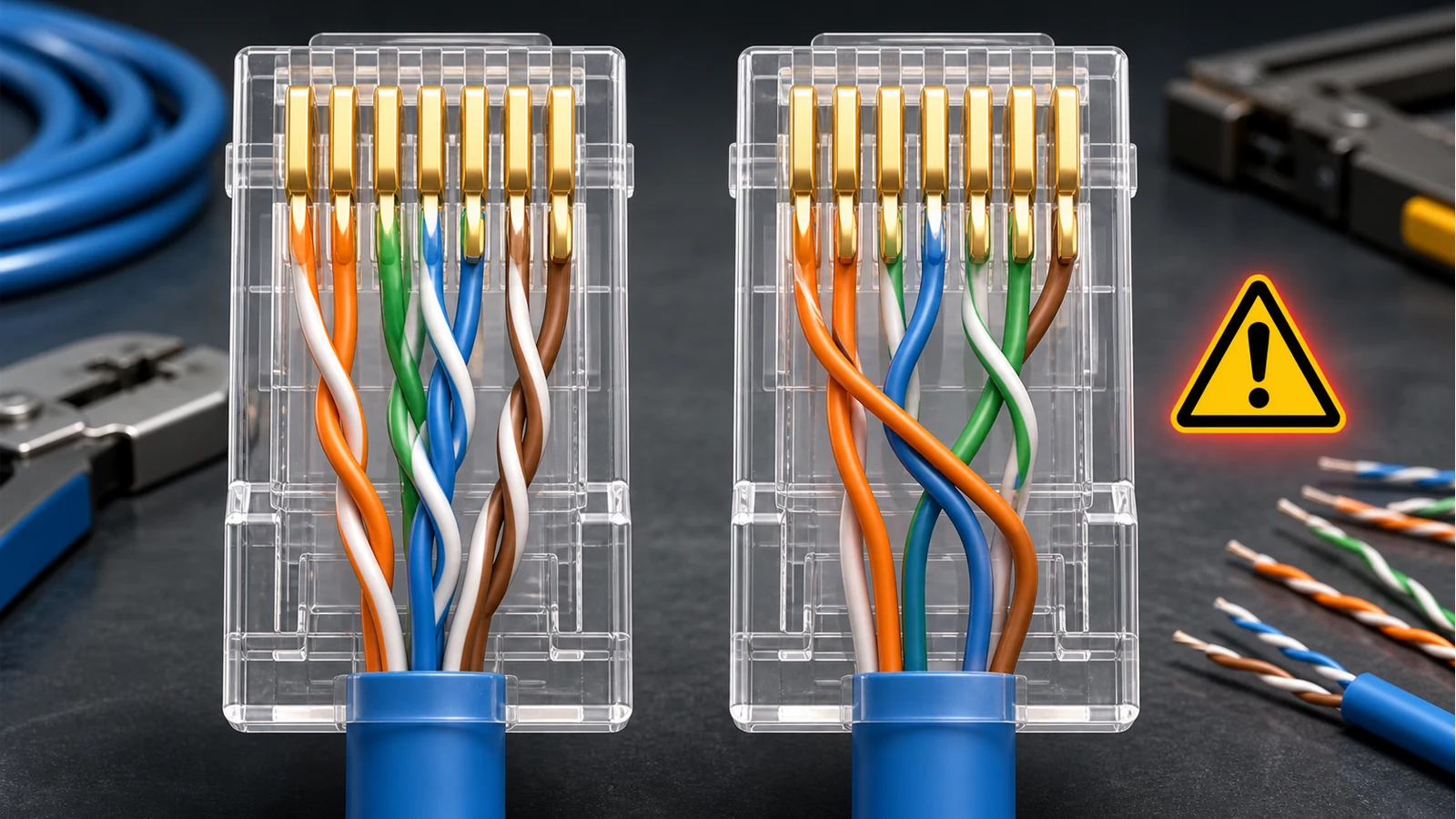
Split pair fault wiremap tester UK: why eight lights can still be wrong
A split pair fault means the conductors may still connect pin to pin, but the correct twisted-pair relationship has been broken. That is why a cheap continuity tester can light all eight LEDs while the link still behaves badly at Gigabit speeds or fails a better wiremap or qualification test.
What a split pair actually is
Fluke Networks explains split pair identification as a fault where continuity can look correct while the pair construction is wrong. CableTestShop gives a plain-language example of how a cable can pass a simple continuity check yet still fail because the proper pairs are not maintained.
Common symptoms
- The cable tester lights 1 to 8 in order, but the network negotiates down or behaves intermittently.
- Gigabit is unreliable even though 100 Mbps appears to work.
- Freshly punched keystone jacks fail after being “checked” with only an LED tester.
- A certification test later reports pair-related performance problems.
Fix checklist
- Confirm whether both ends were terminated to T568A or both to T568B.
- Open the plug or module and inspect pair grouping, not just colour order.
- Re-terminate the suspect end using the chosen scheme.
- Replace short patch leads first if the fixed link is hard to access.
- Retest with a tool that can identify pair faults, not only pin continuity.
What the better tester adds
A wiremap tester with split-pair detection or a qualification/certification tool checks more than “does pin 1 reach pin 1?”. UK-distributed instrument literature such as the Hioki 3665 catalogue from MDL Technologies shows split-pair detection being treated as a distinct capability. Do not assume every mid-price tester has that feature; check the actual specification before buying.
Split pair vs open conductor
An open conductor means a pin is not connected through the run. A split pair means the pin may connect, but the wrong conductors have been paired together. The repair for both is often re-termination, but the diagnosis is different.