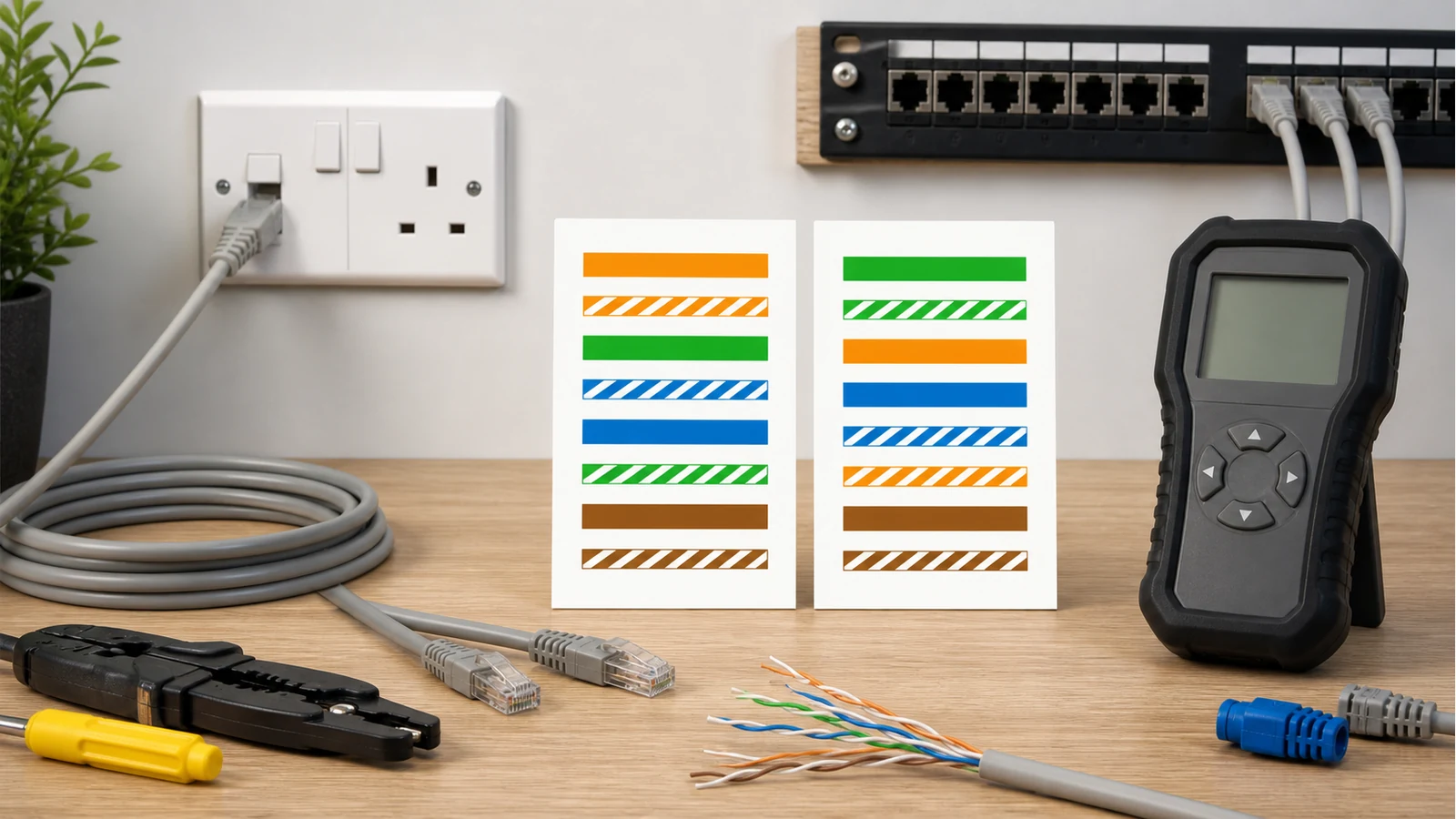
T568B vs T568A wiremap UK: pick one scheme and prove both ends match
For most new UK office and home data-cabling work, use T568B consistently unless the site already uses T568A or the project specification says otherwise. The important test is not whether A or B is magically faster; it is whether both ends of the same link follow the same pin order and the wiremap proves every pair lands where it should.
The practical rule
UK installer guidance from Blake UK wiring instructions treats T568A and T568B as valid wiring schemes, but it is clear that the two ends must match for a straight-through Ethernet link. A UK Cat6 installation guide from Constructive IT also frames T568B as the common choice for new commercial work. Excel Networking guidance gives useful standards context: preference and project convention matter, but the installer should not turn that into a false claim that one scheme is always legally mandatory.
What the wiremap should prove
- Pin 1 at one end maps to pin 1 at the other end, pin 2 to pin 2, and so on for a straight-through link.
- The orange and green pairs are not crossed because one end was terminated as A and the other as B.
- Each pair remains paired correctly; do not confuse simple continuity with a proper wiremap check.
- Any re-punched module is retested before the faceplate is closed or the cabinet is labelled.
Checklist before you label the link
- Check the existing cabinet or client spec. If it already uses T568A, stay with T568A.
- If it is a new unmanaged install, choose T568B and write that choice on the job notes.
- Terminate the wall outlet and patch-panel port to the same scheme.
- Run a wiremap test from one end to the remote at the other end.
- Label both ends only after the wiremap passes.
- If you re-punch one pair, retest the whole link, not just the pair you touched.
If the wiremap shows orange and green crossed
Treat that as an A/B mix first. It is usually faster to open both ends and compare the colour order than to blame the cable in the wall. If the link was intentionally made as an old crossover lead, mark it as a patch lead exception, not as a permanent-link wiring habit.
When a basic continuity tester is not enough
A low-cost LED continuity tester can be useful for finding a completely open conductor, but it may not tell the whole story on pair order and Gigabit readiness. For installed CAT5e or CAT6, a wiremap-capable tester is the minimum sensible check before handover. If the client asks for standards certification, that is a different level of instrument and report.
FAQ
Does T568A or T568B change Ethernet speed?
No. With the same cable category and workmanship, the scheme itself is not the speed limiter. Mixed or badly terminated pairs are the problem.
Can one end be T568A and the other T568B?
That creates a crossover arrangement. It may be deliberate for a standalone patch lead in older contexts, but it is usually wrong for modern fixed office or home cabling.